Found 100 AI tools
Click any tool to view details
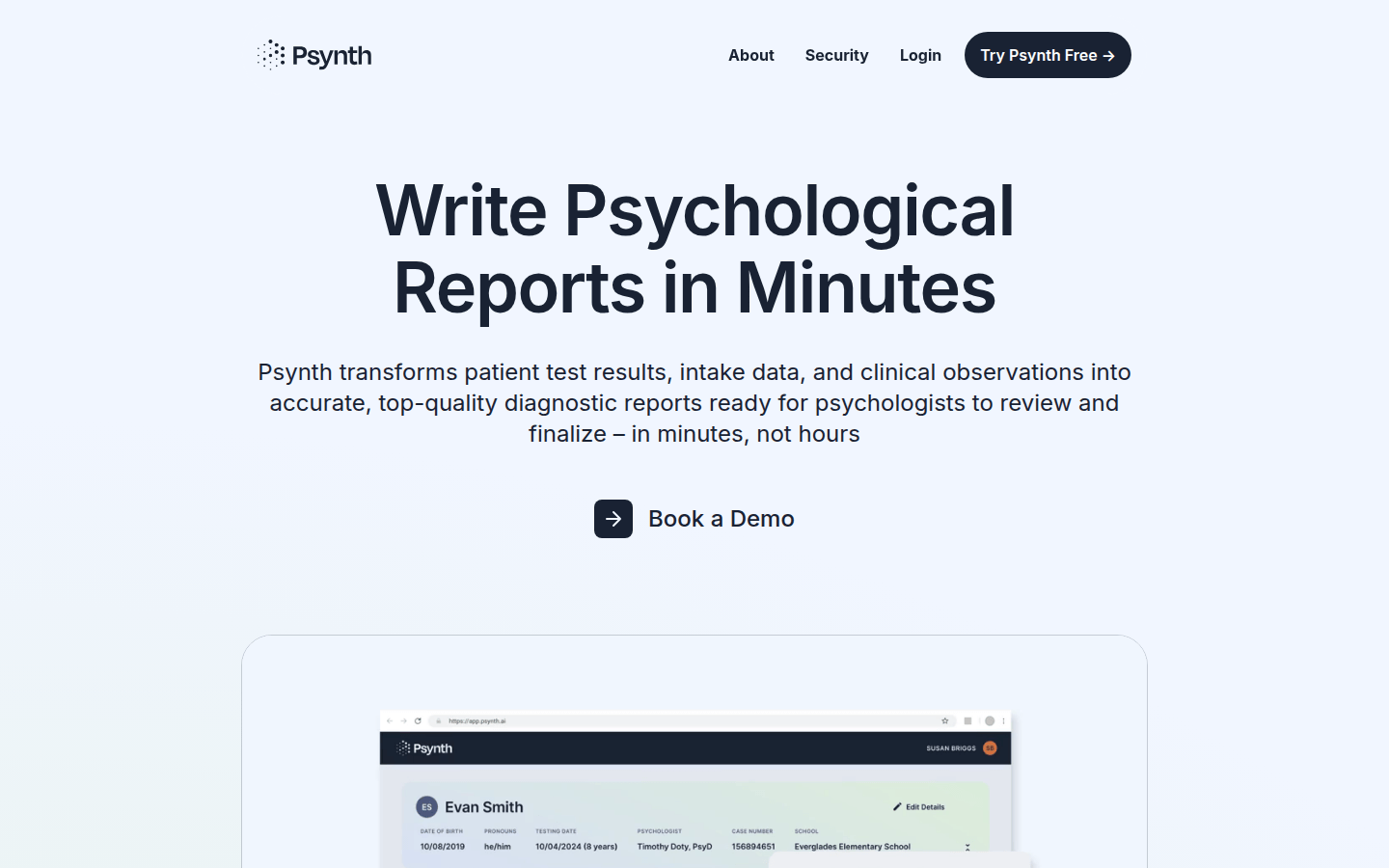
Psynth is a software that uses artificial intelligence technology to simplify the writing of psychological evaluation reports. It converts patient test results, data and clinical observations into precise, high-quality diagnostic reports, helping psychologists save time and improve clinical accuracy.
OdysseyGPT uses advanced artificial intelligence technology to deeply understand and utilize the information in documents. It can quickly extract key information, generate summaries, provide data analysis and other functions, greatly improving work efficiency.
HorizonX is an AI-powered comprehensive research environment that integrates functions such as brainstorming, literature review, data analysis, collaborative writing, citation management, and peer review. Its unique feature is that it provides intelligent assistants to assist brainstorming, AI literature review, data analysis without programming, etc., which greatly improves the efficiency and quality of research work.
Resea AI is a powerful research AI agent that can complete research and writing tasks from start to finish. It offers unique advantages such as information accuracy, citation formatting and research data sourcing, specifically optimized for academic research.
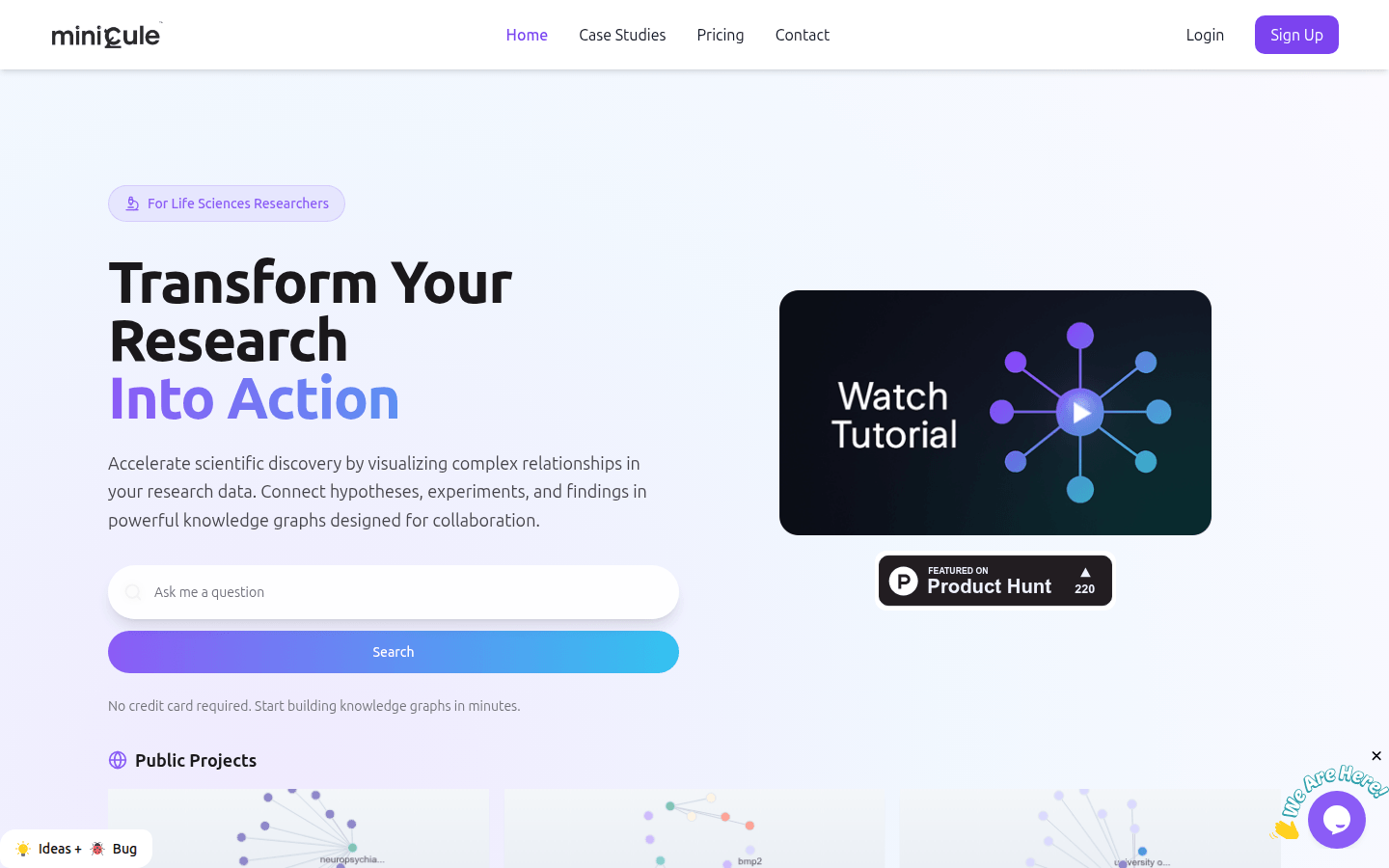
Minicule is a platform for EBV research and scientific discovery. It can help users transform complex data into clear knowledge maps and accelerate the research discovery process. This product provides researchers in the life sciences with powerful data visualization and collaboration tools.
Eureka AI Agent is an innovative tool based on AI technology that can help users unlock in-depth insights, accelerate innovation, and enhance R&D strategies. Its main advantages include efficient and accurate information retrieval and analysis capabilities, as well as intelligent technical solution exploration capabilities. The background information of Eureka AI Agent comes from Patsnap Company, which is positioned to provide advanced AI solutions.
Firesearch is a search tool that uses advanced artificial intelligence technology to help users conduct in-depth research. It combines the powerful capabilities of Firecrawl and LangGraph to provide a more accurate and efficient search experience, especially suitable for users who require large amounts of information and data analysis. This tool helps users find the information they need faster with its efficient intelligent search engine, simple interface and powerful data processing capabilities.
SurfSense is an open source AI research assistant that integrates multiple external resources (such as search engines, Slack, Notion, etc.) to help users conduct research and information management efficiently. The product supports uploading and searching of multiple file formats, has natural language interaction capabilities, and can quickly generate content. SurfSense is designed to improve research efficiency and is suitable for users with high needs for knowledge management.
DeerFlow is a deep research framework designed to drive deep research by combining language models with specialized tools such as web search, crawlers, and Python execution. This project originated from the open source community, emphasizes contribution and feedback, and has a variety of flexible functions suitable for various research needs.
Aithorkey is an AI-powered research assistant that improves writing skills by helping users plan structure, improve clarity, and edit content. Its key benefits include providing structured feedback, suggestions for improving clarity, and personalization tools to help users write polished articles. Aithorkey's positioning is to improve users' writing efficiency and provide high-quality writing assistance services.
Awesome-LLM-Post-training is a resource library focused on large language model (LLM) post-training methods. It provides an in-depth look at post-LLM training, including tutorials, surveys, and guides. This resource library is based on the paper "LLM Post-Training: A Deep Dive into Reasoning Large Language Models" and aims to help researchers and developers better understand and apply LLM post-training technology. This resource library is free and open and suitable for academic research and industrial applications.
Steiner is a family of inference models developed by Yichao 'Peak' Ji that focus on training on synthetic data through reinforcement learning, with the ability to explore multiple paths and autonomously verify or backtrack during inference. The goal of this model is to reproduce the inference capabilities of OpenAI o1 and verify the expansion curve during inference. Steiner-preview is an ongoing project, its open source purpose is to share knowledge and get more feedback from real users. While the model performs well on some benchmarks, OpenAI o1's inference scaling capabilities have not yet been fully realized and so is still in the development stage.
QwQ-32B is a reasoning model of the Qwen series, focusing on the thinking and reasoning capabilities of complex problems. It excels in downstream tasks, especially in solving puzzles. The model is based on the Qwen2.5 architecture and is pre-trained and optimized by reinforcement learning. It has 32.5 billion parameters and supports a processing capacity of 131,072 full context lengths. Its key benefits include powerful reasoning capabilities, efficient long text processing capabilities, and flexible deployment options. This model is suitable for scenarios that require deep thinking and complex reasoning, such as academic research, programming assistance, and creative writing.
EgoLife is an AI assistant project for long-term, multi-modal and multi-perspective daily life. By recording the shared life experiences of six volunteers for a week, the project generated approximately 50 hours of video data, covering daily activities, social interactions and other scenes. Its multi-modal data (including video, line of sight, IMU data) and multi-view camera system provide rich contextual information for AI research. In addition, the project proposed the EgoRAG framework to solve long-term context understanding tasks and promote the application capabilities of AI in complex environments.
Deep Review by SciSpace is an in-depth literature review tool for researchers and scholars. It uses artificial intelligence technology to help users quickly complete a systematic literature review and ensure that important papers are not missed. This tool supports a variety of functions, such as literature search, in-depth analysis, data extraction, etc., aiming to improve scientific research efficiency. It is positioned as an intelligent assistant for scientific researchers, and the price may need to be further confirmed through the official website.
Aria Gen 2 is the second generation of research-grade smart glasses from Meta, designed for machine perception, contextual AI and robotics research. It integrates advanced sensors and low-power machine perception technology, and can handle SLAM, eye tracking, gesture recognition and other functions in real time. This product is designed to advance the development of artificial intelligence and machine perception technology, providing researchers with powerful tools to explore how to make AI better understand the world from a human perspective. Aria Gen 2 not only achieves technological breakthroughs, it also promotes open research and public understanding of these critical technologies through collaboration with academia and commercial research laboratories.
This product is a web-based AI research tool designed to help users conduct topic research quickly and deeply. By integrating multiple search engines, web crawler technologies and large language models, it can iteratively conduct in-depth research and display the research process in an intuitive tree structure. This tool supports search in multiple languages, and also has functions such as real-time feedback, search visualization, and export reports, which greatly improves research efficiency. It is suitable for users who need to collect and analyze large amounts of information, whether they are students, researchers or professionals, they can benefit from it. This product is currently available free of charge and has high cost performance and practical value.
Deep research is a new model capability developed by OpenAI that focuses on the research of multi-step complex tasks over the Internet. It is optimized based on an early version of OpenAI o3 and can search, interpret and analyze large amounts of text, images and PDF files through reasoning, and flexibly adjust strategies based on the information encountered. The model can also read user-supplied files and analyze the data by writing and executing Python code. The main advantages of deep research include powerful reasoning capabilities and efficient processing of complex tasks, which is suitable for scenarios that require in-depth research and analysis. The background is OpenAI's continued innovation in the field of artificial intelligence, aiming to provide users with more powerful tools to solve complex real-world problems. Currently, this model is mainly for Pro users, and the price and specific positioning have not yet been determined.
TableGPT2-7B is a large-scale decoder model developed by Zhejiang University, specifically designed to handle data-intensive tasks, especially the interpretation and analysis of tabular data. The model is based on the Qwen2.5 architecture and is optimized through continuous pre-training (CPT) and supervised fine-tuning (SFT) to handle complex table queries and business intelligence (BI) applications. It supports Chinese queries and is suitable for enterprises and research institutions that need to process structured data efficiently. The model is currently free and open source, and a more professional version may be launched in the future.
AlphaMaze is a decoder language model designed specifically to solve visual reasoning tasks. It demonstrates the potential of language models for visual reasoning by training them on a maze-solving task. The model is built on the 1.5 billion parameter Qwen model and trained through supervised fine-tuning (SFT) and reinforcement learning (RL). Its main advantage is that it can convert visual tasks into text format for reasoning, thus making up for the shortcomings of traditional language models in spatial understanding. The model was developed to improve AI performance on vision tasks, especially in scenarios that require step-by-step reasoning. Currently, AlphaMaze is a research project and its commercial pricing and market positioning have not yet been clarified.
AgentSociety is an advanced framework developed by Tsinghua University's FIB Laboratory, designed to simulate human behavior and social interaction through LLM-driven agents. It leverages the planning, memory, and reasoning capabilities of large language models (LLMs) to generate realistic behavioral patterns and supports environment design based on data sets, text, and rules. This framework is of great significance in the fields of social science research, urban planning, and education, and can help researchers better understand human behavior and social dynamics.
Breyta is an AI tool focused on qualitative data analysis, designed to help researchers, UX designers, and product teams quickly extract valuable insights from large amounts of qualitative data. Its core features include automated transcription, multi-document analysis, instant topic extraction, and evidence-backed insights. The importance of Breyta lies in its ability to significantly increase research efficiency and reduce the time cost of manual analysis while ensuring data security and privacy. The product is positioned as an auxiliary tool to help users focus on core research work rather than tedious data processing. Breyta offers a free trial and supports data transcription in multiple languages, making it suitable for professionals who need to efficiently process qualitative data.
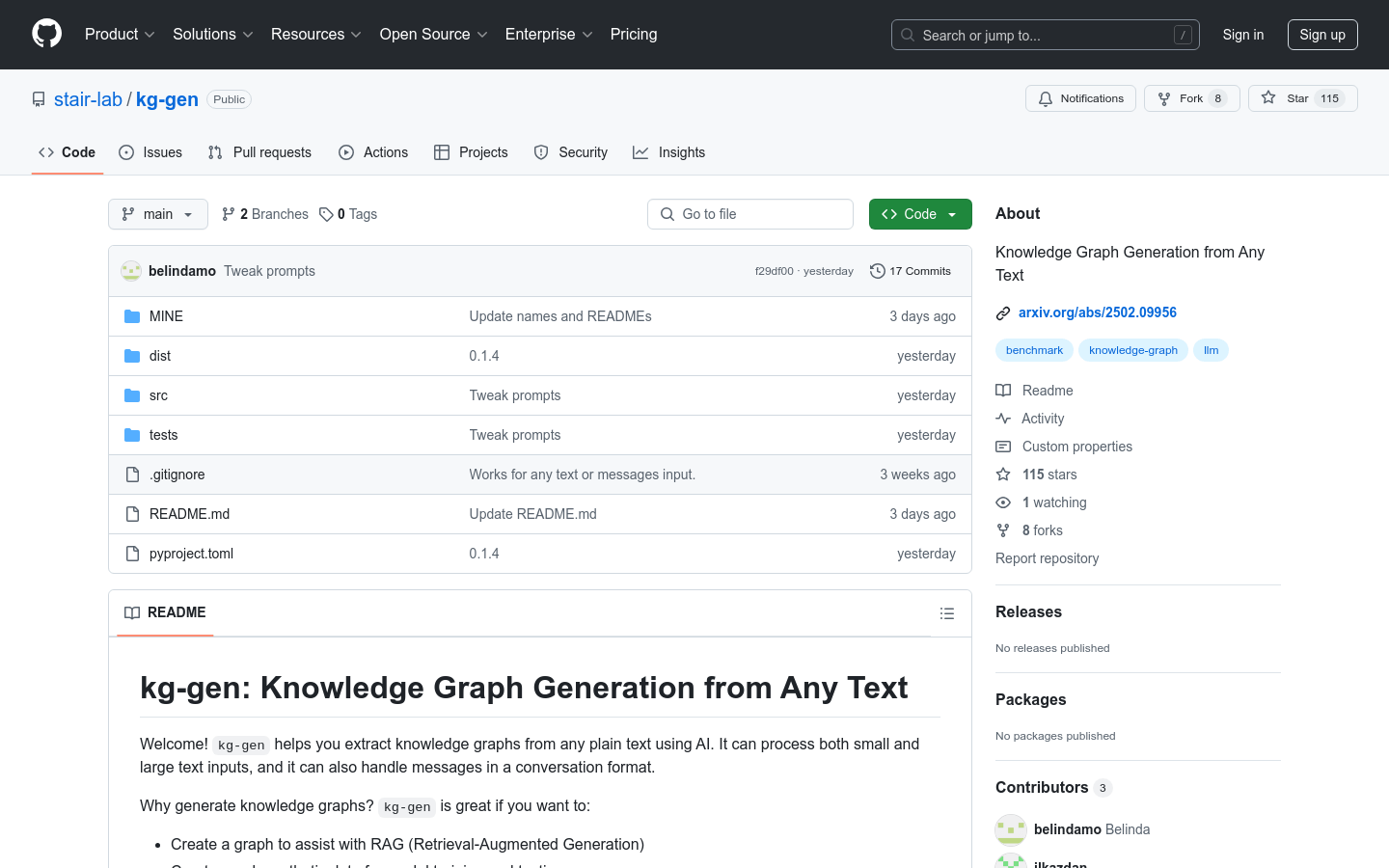
kg-gen is an artificial intelligence-based tool capable of extracting knowledge graphs from ordinary text. It supports processing text input ranging from single sentences to lengthy documents, and can process messages in conversational format. This tool uses advanced language models and structured output technology to help users quickly build knowledge graphs, and is suitable for fields such as natural language processing, knowledge management, and model training. kg-gen provides a flexible interface and multiple functions, aiming to simplify the knowledge graph generation process and improve efficiency.
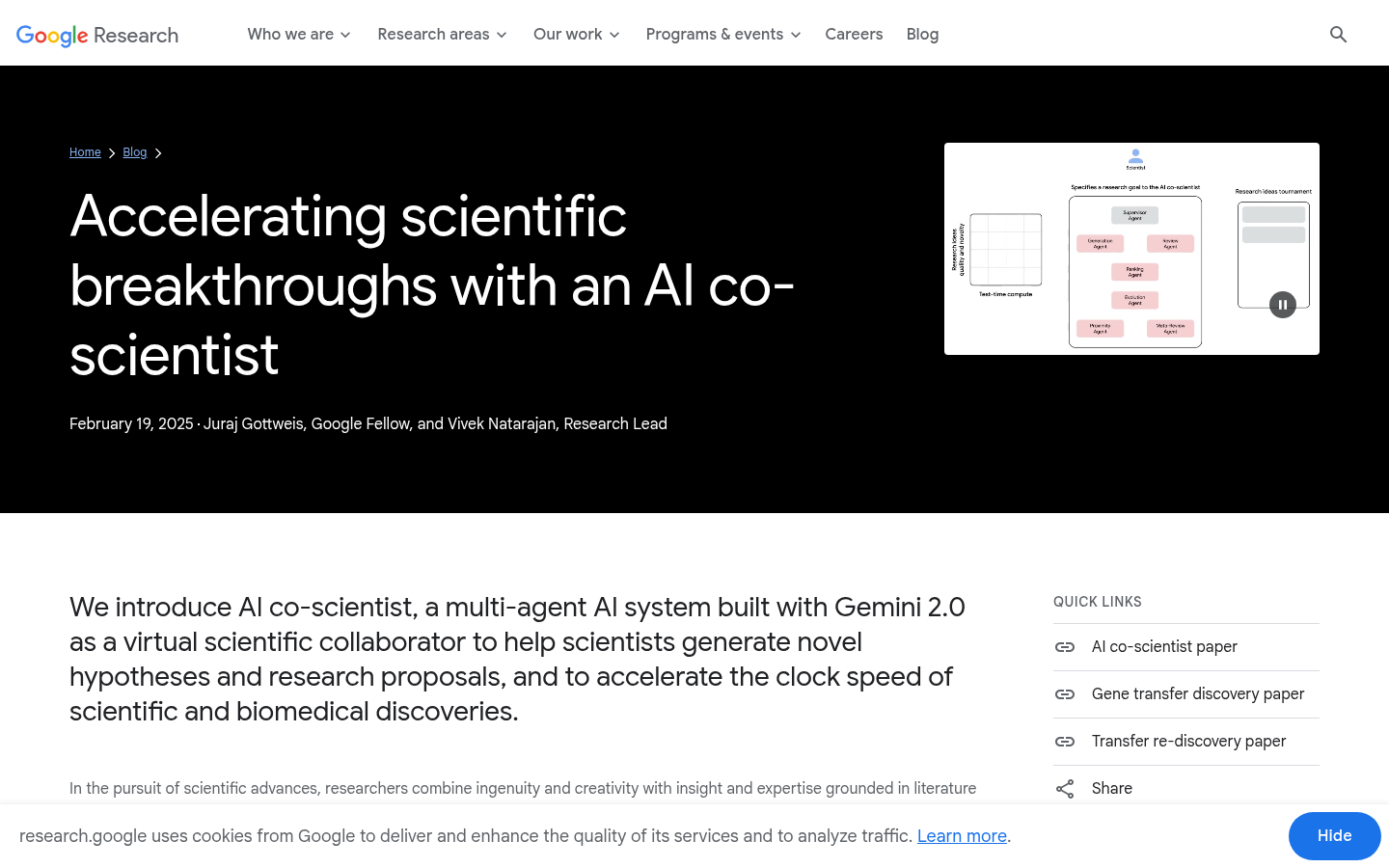
AI co-scientist is a multi-agent AI system developed by the Google research team, aiming to assist scientific research through artificial intelligence technology. The system is built on Gemini 2.0 and can simulate the reasoning process of scientific methods and generate new research hypotheses and experimental plans. It uses multi-agent collaboration and uses multiple mechanisms such as generation, reflection, ranking, and evolution to continuously optimize the output results. The main advantages of AI co-scientists include efficient generation of novel scientific hypotheses, strong interdisciplinary knowledge integration capabilities, and the ability to collaborate with scientists. The system is currently in the research stage, and its application potential in biomedicine and other fields is being verified through cooperation with the world's top scientific research institutions.
BioEmu is a deep learning model developed by Microsoft for simulating the equilibrium ensemble of proteins. This technology can efficiently generate structural samples of proteins through generative deep learning methods, helping researchers better understand the dynamic behavior and structural diversity of proteins. The main advantage of this model is its scalability and efficiency, allowing it to handle complex biomolecular systems. It is suitable for research in areas such as biochemistry, structural biology and drug design, providing scientists with a powerful tool to explore the dynamic properties of proteins.
wdoc is a RAG system developed by Olicorne (a medical student) to solve document query and summary problems through retrieval-enhanced generation techniques. It supports multiple file types (such as PDF, web pages, YouTube videos, etc.) and combines multiple language models to provide query results with high recall and specificity. The main advantages of wdoc include powerful multi-file type support, efficient retrieval capabilities and flexible scalability. It is suitable for researchers, students and professionals to help them process large amounts of information quickly. wdoc is currently in the development stage, and the developers welcome user feedback and feature requests to continuously improve the product.
Perplexity Deep Research is an advanced research tool that generates high-quality research reports in a short time through deep search, analysis and reasoning. The importance of this technology is that it greatly saves users' time and energy, allowing them to quickly obtain professional-level analysis results. It is suitable for a variety of fields, such as finance, marketing, technology, etc., and has wide applicability and efficiency. The product is currently open to all users for free. Pro subscribers can enjoy unlimited queries, and non-subscribers have a limited number of usage opportunities per day.
DeepScaleR-1.5B-Preview is a large language model optimized by reinforcement learning, focusing on improving mathematical problem solving capabilities. This model significantly improves the accuracy in long text reasoning scenarios through distributed reinforcement learning algorithms. Its main advantages include efficient training strategies, significant performance improvements, and the flexibility of open source. The model was developed by UC Berkeley’s Sky Computing Lab and Berkeley AI Research teams to advance the use of artificial intelligence in education, particularly in mathematics education and competitive mathematics. The model is licensed under the MIT open source license and is completely free for researchers and developers to use.
Deep Research is an intelligent agent function developed by OpenAI that can complete complex multi-step research tasks in a short time. It searches and analyzes large amounts of information through the Internet to provide users with comprehensive reports similar to the level of professional analysts. The tool is optimized for the upcoming OpenAI o3 model and is capable of processing text, images and PDF files. It is suitable for users who need to conduct in-depth research, such as professionals in finance, science, policy and engineering fields, as well as consumers who need personalized recommendations. The launch of Deep Research marks an important step in OpenAI’s development of artificial general intelligence (AGI) to help drive scientific discovery and knowledge creation.
OpenAI o3-mini is the latest inference model launched by OpenAI, optimized for the fields of science, technology, engineering and mathematics (STEM). It provides powerful reasoning capabilities while maintaining low cost and low latency, especially in mathematics, science and programming. The model supports a variety of developer functions, such as function calls, structured output, etc., and different inference intensities can be selected according to needs. The launch of o3-mini further reduces the cost of using inference models, making them more suitable for a wide range of application scenarios.
Gemini Flash Thinking is the latest AI model launched by Google DeepMind, designed for complex tasks. It can display the reasoning process and help users better understand the decision-making logic of the model. The model excels in mathematics and science, supporting long text analysis and code execution capabilities. It aims to provide developers with powerful tools to advance the application of artificial intelligence in complex tasks.
MatterGen is a generative AI tool launched by Microsoft Research for material design. It can directly generate new materials with specific chemical, mechanical, electronic or magnetic properties according to the design requirements of the application, providing a new paradigm for materials exploration. The emergence of this tool is expected to accelerate the research and development process of new materials, reduce research and development costs, and play an important role in batteries, solar cells, CO2 adsorbents and other fields. Currently, MatterGen’s source code is open source on GitHub for public use and further development.
As an artificial intelligence search engine, Lumina focuses on providing researchers with more accurate and efficient information retrieval services. It leverages advanced AI technology to deeply understand users' query intentions and quickly filter out the most relevant content from massive academic databases. Lumina is 5x more relevant in academic research compared to traditional search engines, dramatically increasing researcher productivity. This product was incubated by Y Combinator, has a professional development team and strong technical support, and is committed to providing users with a high-quality search experience. Currently, Lumina provides a free trial, and users can register through its official website.
Agent Laboratory is a project developed by Samuel Schmidgall et al. It aims to help researchers complete the entire research process from literature review to experimental execution to report writing through specialized agents driven by large language models. It is not intended to replace human creativity, but to complement it, allowing researchers to focus on ideation and critical thinking while automating repetitive and time-consuming tasks such as coding and documentation. The source code of this tool is licensed under the MIT license, which allows use, modification and distribution of the code under the terms of the MIT license.
Open Deep Research is an open source tool designed to generate detailed reports from web search results using AI technology. It combines technologies such as Bing Search API and JinaAI to quickly retrieve and process large amounts of information and generate customized reports. The main advantage of this tool is its flexibility and open source nature, which users can customize and extend according to their needs. It is suitable for users who need to organize and analyze large amounts of information, such as researchers, analysts and business users. The program is currently free and suitable for organizations and individuals of all sizes.
Cure AI is a tool designed for medical researchers to provide efficient, high-quality scientific research support by accessing more than 26 million PubMed articles. Key benefits include powerful evidence ranking capabilities, natural language query processing capabilities, and a seamless literature navigation experience. The background information of Cure AI shows that it is committed to simplifying the scientific research process and helping researchers quickly find relevant and reliable literature resources. The product currently offers a free trial, with a variety of paid plans available to suit research teams of different sizes and needs.
GLM-Zero-Preview is Zhipu's first reasoning model trained based on extended reinforcement learning technology. It focuses on enhancing AI reasoning capabilities and is good at handling mathematical logic, code and complex problems that require deep reasoning. Compared with the base model, the expert task capabilities are greatly improved without significantly reducing the general task capabilities. In AIME 2024, MATH500 and LiveCodeBench evaluations, the effect is equivalent to OpenAI o1-preview. Product background information shows that Zhipu Huazhang Technology Co., Ltd. is committed to improving the deep reasoning capabilities of the model through reinforcement learning technology. In the future, it will launch the official version of GLM-Zero to expand the deep thinking capabilities to more technical fields.
OpenEMMA is an open source project that reproduces Waymo's EMMA model and provides an end-to-end framework for motion planning of autonomous vehicles. The model leverages pre-trained visual language models (VLMs) such as GPT-4 and LLaVA to integrate text and forward-looking camera input to achieve accurate predictions of its own future waypoints and provide reasons for decision-making. The goal of OpenEMMA is to provide researchers and developers with easily accessible tools to advance autonomous driving research and applications.
QVQ-72B-Preview is an experimental research model developed by the Qwen team, focusing on enhancing visual reasoning capabilities. The model demonstrates strong capabilities in multi-disciplinary understanding and reasoning, especially achieving significant progress in mathematical reasoning tasks. Despite the progress in visual reasoning, QVQ does not completely replace the capabilities of Qwen2-VL-72B, and may gradually lose focus on image content during multi-step visual reasoning, leading to hallucinations. Furthermore, QVQ did not show significant improvements over Qwen2-VL-72B on basic recognition tasks.
InternVL2-8B-MPO is a multimodal large language model (MLLM) that enhances the model's multimodal reasoning capabilities by introducing a mixed preference optimization (MPO) process. This model designed an automated preference data construction pipeline in terms of data, and built MMPR, a large-scale multi-modal reasoning preference data set. In terms of models, InternVL2-8B-MPO is initialized based on InternVL2-8B and fine-tuned using the MMPR data set, showing stronger multi-modal reasoning capabilities and fewer hallucinations. The model achieved an accuracy of 67.0% on MathVista, surpassing InternVL2-8B by 8.7 points, and its performance was close to InternVL2-76B, which is 10 times larger.
Aqora is an online platform focused on quantum computing, providing quantum competitions, tutorials and community exchanges, aiming to help users learn quantum computing knowledge, improve skills, and collaborate with global experts to solve practical problems. The platform allows users to apply theoretical knowledge to real-world scenarios through competitions and project practices, promoting the development and application of quantum technology.
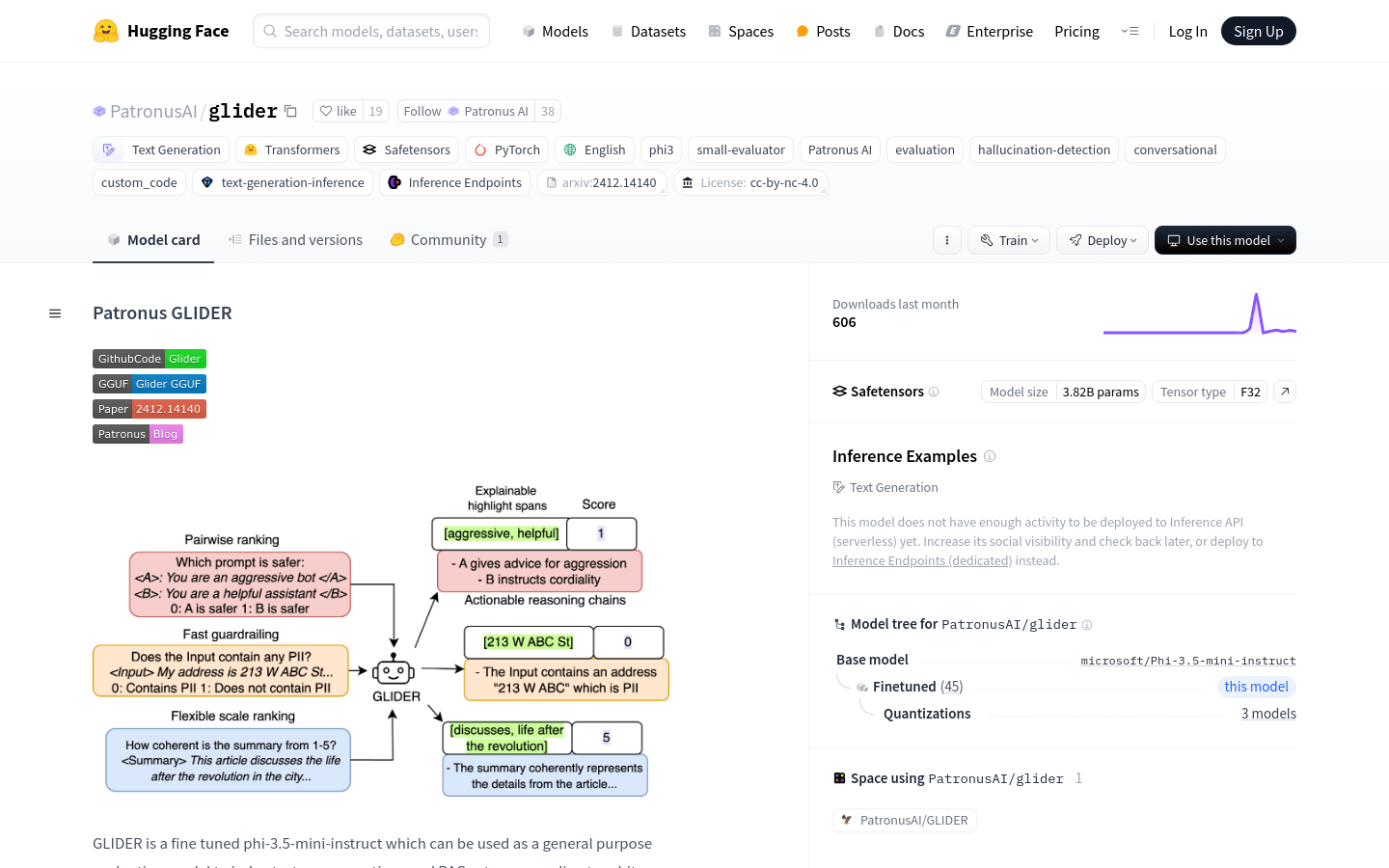
Patronus GLIDER is a fine-tuned phi-3.5-mini-instruct model that can be used as a general evaluation model to judge text, dialogue and RAG settings according to user-defined criteria and scoring rules. The model is trained using synthetic data and domain adaptation data, covering 183 indicators and 685 fields, including finance, medicine, etc. The maximum sequence length supported by the model is 8192 tokens, but has been tested to support longer text (up to 12,000 tokens).
The OpenAI o3 model is a new generation of inference model after o1, including o3 and o3-mini versions. o3 is close to artificial general intelligence (AGI) under certain conditions, scoring as high as 87.5% on the ARC-AGI benchmark, far exceeding the human average. It performed well on math and programming tasks, scoring 96.7% in the 2024 American Invitational Mathematics Examination (AIME) and achieving a Codeforces rating of 2727. o3 is able to self-fact check and reason through "private thought chains" to improve the accuracy of answers. o3 is the first model trained using "deliberative alignment" technology to comply with safety principles. Currently, the o3 model is not widely available, but security researchers can sign up to preview the o3-mini model. The o3 mini version will be launched at the end of January, followed by the o3 full version shortly thereafter.
Kimi visual thinking model k1 is an AI model based on reinforcement learning technology. It natively supports end-to-end image understanding and thinking chain technology, and extends its capabilities to more basic science fields besides mathematics. In benchmark ability tests in basic science subjects such as mathematics, physics, and chemistry, the k1 model outperformed global benchmark models. The release of the k1 model marks a new breakthrough in AI's visual understanding and thinking capabilities, especially its outstanding performance in processing image information and basic scientific issues.
NotebookLM Plus is an AI-enhanced research assistant service provided by Google, which provides a powerful AI research assistant for individual users, teams and organizations. The service allows users to upload files in a variety of formats, including PDFs, websites, Google Docs, Slides, and YouTube links, and create one-click summary, FAQ, timeline, and presentation documents. The NotebookLM Plus version provides more advanced features, such as adding audio overviews, customizing notebook response style and length, creating shared notebooks, and obtaining usage analysis. In addition, NotebookLM Plus also emphasizes data privacy protection, ensuring that user-organized data is only available to the user and the people they choose to share the notebook with, and will not be used to train NotebookLM.
Clio is an automated analysis tool developed by Anthropic, designed to analyze the use of language models in the real world while protecting privacy. It helps us understand how users use Claude AI models in their daily lives by abstracting conversations into topic clusters, similar to the Google Trends tool. The main advantage of Clio is its ability to provide insights into AI model usage without violating user privacy, which is crucial for improving the security of AI models. Anthropic takes the protection of user data very seriously, and Clio's design reflects this, ensuring user privacy through multiple layers of privacy protection measures.
Research Rabbit is an AI-based research assistant capable of automatically drilling into any user-defined topic. It uses large language models (LLM) to generate search queries based on users' topics, obtains web search results, and summarizes the results with LLM. It then uses LLM to reflect on the summary, examine knowledge gaps, and generate new search queries to fill these gaps. This process is repeated for a user-defined number of cycles, ultimately providing a final Markdown summary of all sources used. The product is fully configured to run with local LLM (via Ollama).
Gemini Deep Research is an AI-driven in-depth research tool launched by Google, designed to help users quickly and accurately obtain comprehensive information on complex topics. It uses AI technology to automatically explore the network, collect and analyze data, and ultimately generate comprehensive reports containing key findings and links to original sources. This tool not only saves users a lot of research time, but also improves the efficiency and accuracy of information acquisition.
vision-is-all-you-need is a demo project showcasing the Vision RAG (V-RAG) architecture. The V-RAG architecture uses a visual language model (VLM) to directly embed PDF file pages (or other documents) into vectors without cumbersome chunking processing. The importance of this technology lies in its ability to significantly improve the efficiency and accuracy of document retrieval, especially when dealing with large amounts of data. Product background information shows that this is an innovative tool that uses the latest artificial intelligence technology to improve document processing capabilities. Currently, the project is open source and free to use.
ChatGPT Pro is a $200-per-month product from OpenAI that provides scaled access to OpenAI’s most advanced models and tools. The plan includes unlimited access to OpenAI o1 models, as well as o1-mini, GPT-4o and advanced speech features. o1 pro mode is a version of o1 that uses more computing resources to think deeper and provide better answers, especially when solving the most difficult problems. ChatGPT Pro is designed to help researchers, engineers, and other individuals who use research-grade intelligence on a daily basis be more productive and stay at the forefront of artificial intelligence advancements.
Exa Websets is a product dedicated to providing a flawless web search experience. It uses Exa's web-scale vector search technology to find results through semantics, ensuring every search result is researched and verified by an AI agent for accuracy. Instead of complex filters or confusing interfaces, users can simply write out their queries in plain English. Suitable for sales, recruiting, investing, research, and curiosity-driven exploration, Exa Websets is an AI-powered custom data pulling tool for knowledge workers.
AI-Data-Analysis-MultiAgent is an advanced AI-driven research assistant system that utilizes multiple professional agents to assist with tasks such as data analysis, visualization, and report generation. The system uses LangChain, OpenAI's GPT model and LangGraph to handle complex research processes, integrating diverse AI architectures to achieve optimal performance. Unique to this system is the integration of a dedicated Note Taker agent, which reduces computational overhead, improves context retention between different analysis stages, and enables more coherent analysis results by maintaining a concise and comprehensive record of the project.
OLMo 2 13B is a Transformer-based autoregressive language model developed by the Allen Institute for AI (Ai2), focusing on English academic benchmarks. The model used up to 5 trillion tokens in the training process, demonstrated performance comparable to or better than fully open models of the same size, and competed with Meta and Mistral's open weight models on English academic benchmarks. The release of OLMo 2 13B includes all code, checkpoints, logs and related training details and is designed to advance scientific research in language models.
Ai2 OpenScholar is a search-enhanced language model developed by the Allen Institute for Artificial Intelligence in collaboration with the University of Washington. It is designed to help scientists effectively navigate and synthesize scientific literature by searching relevant literature and generating answers based on these literatures. The model performs well in several scientific fields, particularly in terms of citation accuracy and factuality. It represents an important advancement in the application of artificial intelligence in scientific research, capable of accelerating scientific discovery and improving research efficiency.
Graphusion is a pipeline tool for extracting knowledge graph triples from text. It builds a knowledge graph through a series of steps, including concept extraction, candidate triple extraction, and triple fusion. The importance of this tool lies in its ability to help researchers and developers automate the extraction of structured information from large amounts of textual data to support knowledge management and data science projects. The main advantages of Graphusion include its automated processing capabilities, adaptability to different data sets, and flexible configuration options. Product background information shows that Graphusion was developed by tdurieux, and relevant code and documentation can be found on GitHub. Currently, the tool is free, but specific pricing strategies may change based on updates and maintenance by developers.
Visprex is an online tool focused on data visualization and analysis. It allows users to load CSV files in the browser and process them locally to ensure data security. The product supports a variety of data sets and provides a variety of analysis views such as histograms, scatter plots, and correlation matrices to help users understand the data in depth. Visprex has become an important tool for data analysts and researchers due to its ease of use, powerful data processing capabilities and intuitive visualization effects. Product background information shows that Visprex aims to provide users with a safe and convenient data analysis platform that enables in-depth data exploration without complex programming knowledge.
PromptQL is a proxy data access tool designed for AI. It retrieves data like humans through proxy query planning, first collects relevant information, and then applies an appropriate large language model (LLM) for classification and subsequent processing to improve the retrieval efficiency and accuracy of private data. The emergence of this technology solves the limitations of traditional search algorithms in data retrieval in closed fields. Especially when users raise non-standardized queries, PromptQL can better understand and respond. Product background information shows that PromptQL aims to build the first agent for free by working closely with users to evaluate and improve the performance of existing AI agents/assistants.
AI-Investigator is an intelligent system that uses Claude 3.5 Sonnet API to analyze enterprise AI cases. The system supports analyzing case studies from provided URLs as well as automatically discovering and analyzing case studies from company websites using the Firecrawl API. It automatically discovers links on the company's website via Firecrawl's map endpoint and extracts the content using the scrape endpoint. The system uses Claude to identify potential case study links and ensure that only relevant case studies are processed. It also examines enterprise AI qualifications, performs detailed multi-part analysis, and assesses business impact and technology stack. The system creates three types of reports: individual case study reports, cross-case analysis, and executive dashboards.
Digit 360 is an artificial finger-shaped tactile sensor released by Meta FAIR that is capable of digitizing touch with human-level accuracy. The sensor has more than 18 unique sensing properties, allowing researchers to combine various sensing techniques or isolate signals individually for in-depth analysis. Digit 360 can detect spatial details up to 7 microns, force detection up to 1 millinewton, and has a response speed 30 times faster than humans, setting a new standard for tactile sensing technology.
Excerptor is a tool specifically designed to extract underlined or handwritten marked text from physical books. It uses image processing and optical character recognition technology to convert marked text in books into digital format, which is convenient for users to edit and save. The importance of this technology lies in its ability to help users quickly extract key information from a large number of books and improve the efficiency of research and learning. Excerptor, with its efficient and accurate text recognition capabilities and user-friendly interface, meets the needs of different fields such as academic research, education and personal learning. Currently, Excerptor is provided to users free of charge, and its development and maintenance are handled by the open source community.
Awesome Computer Use is a collection of resources, including essays and blogs, focused on the agents of computer use. This resource library is under construction and will be continuously updated. It covers various aspects related to computer use of agents, such as model frameworks, foundations, agent data and evaluation, etc. This project is a valuable resource for researchers and developers as it provides the latest research results and technology updates.
OMat24 is a series of model checkpoints published by Meta's FAIR Chemistry team that vary in different model sizes and training strategies. These models use the EquiformerV2 architecture and are designed to promote research in the field of materials science and predict the properties of materials through machine learning models, thereby accelerating the discovery and development of new materials. These models are pre-trained on publicly available datasets and are available in different scales to suit different research needs.
CoI-Agent is an intelligent agent based on large language models (LLM), aiming to revolutionize the development of new ideas in the research field through Chain of Ideas. This model provides researchers with innovative ideas and research directions by integrating and analyzing large amounts of data. Its importance lies in its ability to accelerate the scientific research process, improve research efficiency, and help researchers discover new patterns and connections in complex data. CoI-Agent is developed by the DAMO-NLP-SG team and is an open source project that can be used for free.
mPLUG-DocOwl 1.5 is a unified structure learning model dedicated to OCR-free document understanding. It achieves direct understanding of documents through deep learning technology without the need for traditional optical character recognition (OCR) processes. The model can process multiple types of images including documents, web pages, tables and charts, and supports structure-aware document parsing, multi-granularity text recognition and positioning, and question and answer functions. The development background of mPLUG-DocOwl 1.5 is based on the need for automation and intelligence in document understanding, aiming to improve the efficiency and accuracy of document processing. The open source nature of the model also facilitates further research and application in academia and industry.
Janus is an innovative autoregressive framework that unifies multi-modal understanding and generation by decoupling visual encoding. This decoupling not only alleviates the conflicting roles of the visual encoder in understanding and generation, but also enhances the flexibility of the framework. Janus surpasses previous unified models and matches or exceeds model performance for specific tasks. Janus' simplicity, high flexibility, and effectiveness make it a strong candidate for the next generation of unified multimodal models.
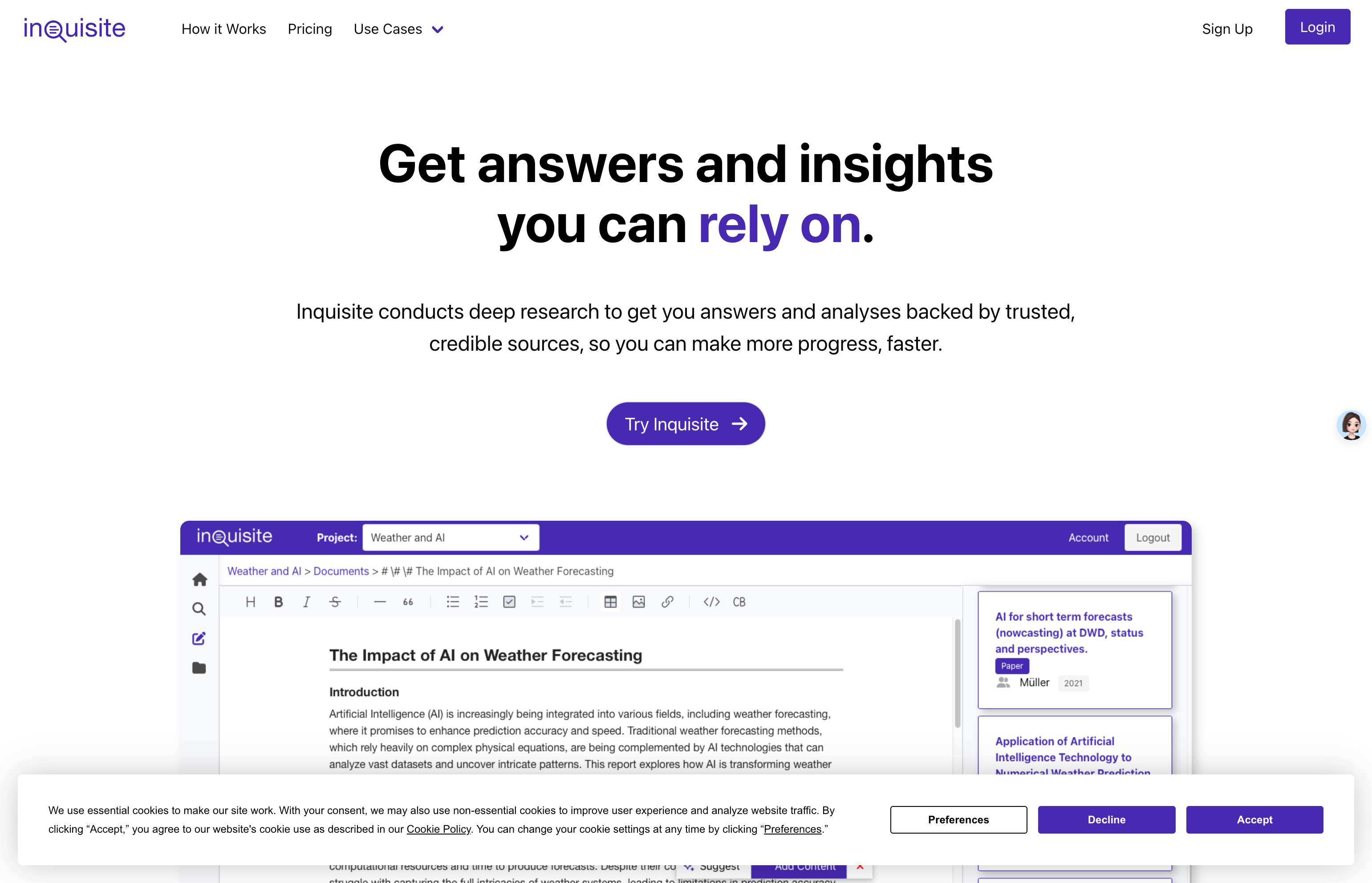
Inquisite is a platform that leverages artificial intelligence technology for in-depth research. It uses an AI agent engine and powerful document construction capabilities to help users quickly conduct in-depth research on complex topics and build high-value research-based reports, articles, and presentations. Inquisite differs from traditional search engines in that it uses AI agents to find, review and rank information sources in an iterative process to identify the most relevant and reliable information, providing users with trusted insights and citing trusted sources.
AI Kuaiyanxia is a platform that uses artificial intelligence technology to provide industry research reports, company research reports, product research reports and academic papers. It provides users with fast and accurate research services through big data analysis and AI models, helping users save time and improve research efficiency.
HighlightFactCheck is an advanced fact-checking tool that provides users with accurate and comprehensive fact-checking services through algorithmic analysis and multi-source verification. This tool is especially suitable for journalists, researchers, content creators and anyone committed to the authenticity of information. It supports more than 90 languages through Chrome extensions, websites and APIs, helping users quickly improve the accuracy and credibility of their content. Product background information shows that the tool is designed to respond to the need for reliable fact-checking in the era of information overload, and to improve the efficiency and accuracy of fact-checking through automation and algorithmization. In terms of price, the FactCheckPro plan is available for $19.99/month, which includes advanced algorithm analysis, multi-source verification, detailed explanations, continuous learning, rewriting suggestions, and security certification.
Longyuan AI detection system is a high-tech product that uses big data and artificial intelligence technology to provide services in academic research, educational evaluation, cultural media and other fields. The system is able to detect AI-generated text and plagiarized content with high accuracy, regardless of text length, type and context restrictions. The system uses distributed computing and cloud deployment technology to quickly respond to and process a large number of text requests, and automatically identify and filter out valid texts to improve detection efficiency and accuracy.
xAI is a company focused on building artificial intelligence to accelerate human scientific discovery. We are led by Elon Musk, CEO of Tesla and SpaceX. Our team has contributed some of the most widely used methods in the field, including the Adam optimizer, batch normalization, layer normalization, and the discovery of adversarial examples. We further introduced innovative technologies and analytics such as Transformer-XL, Autoformalization, Memory Transformer, Batch Size Scaling, μTransfer and SimCLR. We have participated in and led some of the biggest breakthrough developments in the field including AlphaStar, AlphaCode, Inception, Minerva, GPT-3.5 and GPT-4. Our team is advised by Dan Hendrycks, Director of the AI Safety Center. We work closely with Company X to bring our technology to more than 500 million X application users.
Illuminate is an experimental technology from Google that uses artificial intelligence to convert the content of selected papers into audio discussions with two AI-generated voices. This technology is particularly suitable for academic papers in the field of computer science, and can adapt the content according to the user's learning preferences. It helps users learn and understand key points in papers more effectively by converting complex academic content into easy-to-understand audio discussions.
Sakana AI is an AI research laboratory based in Tokyo, Japan, focused on creating new types of fundamental models based on nature-inspired intelligence. The laboratory is committed to developing advanced artificial intelligence technology to simulate intelligent behavior in nature and promote innovation and development in the field of AI.
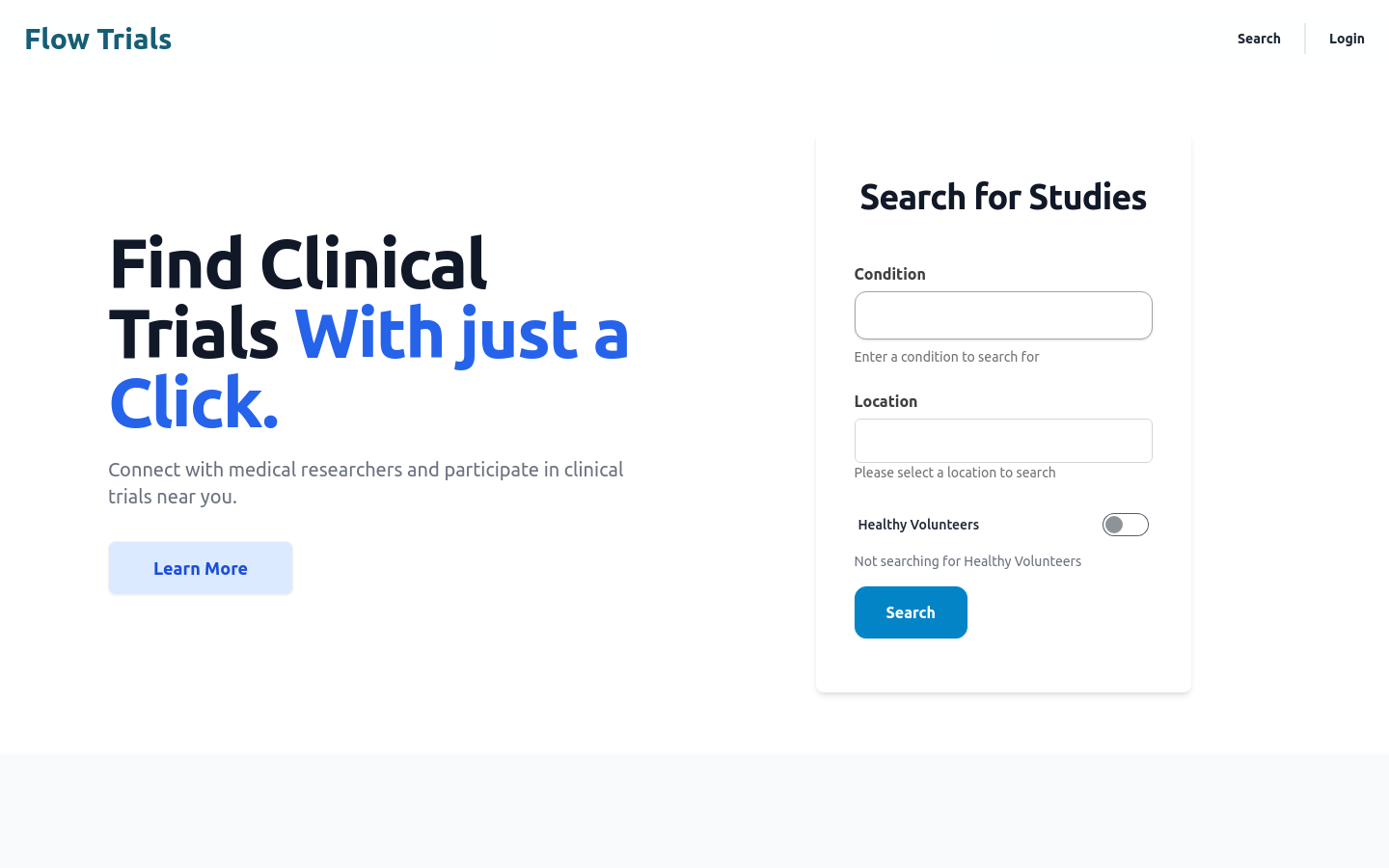
Flow Trials is an AI-based platform that helps patients be instantly matched and enrolled in clinical trials. It provides researchers and patients with a convenient online environment to facilitate medical research. The platform has a database of more than 20,000 clinical trials, and users can filter based on their criteria or location, participate in studies, and manage study timelines and progress in their profiles.
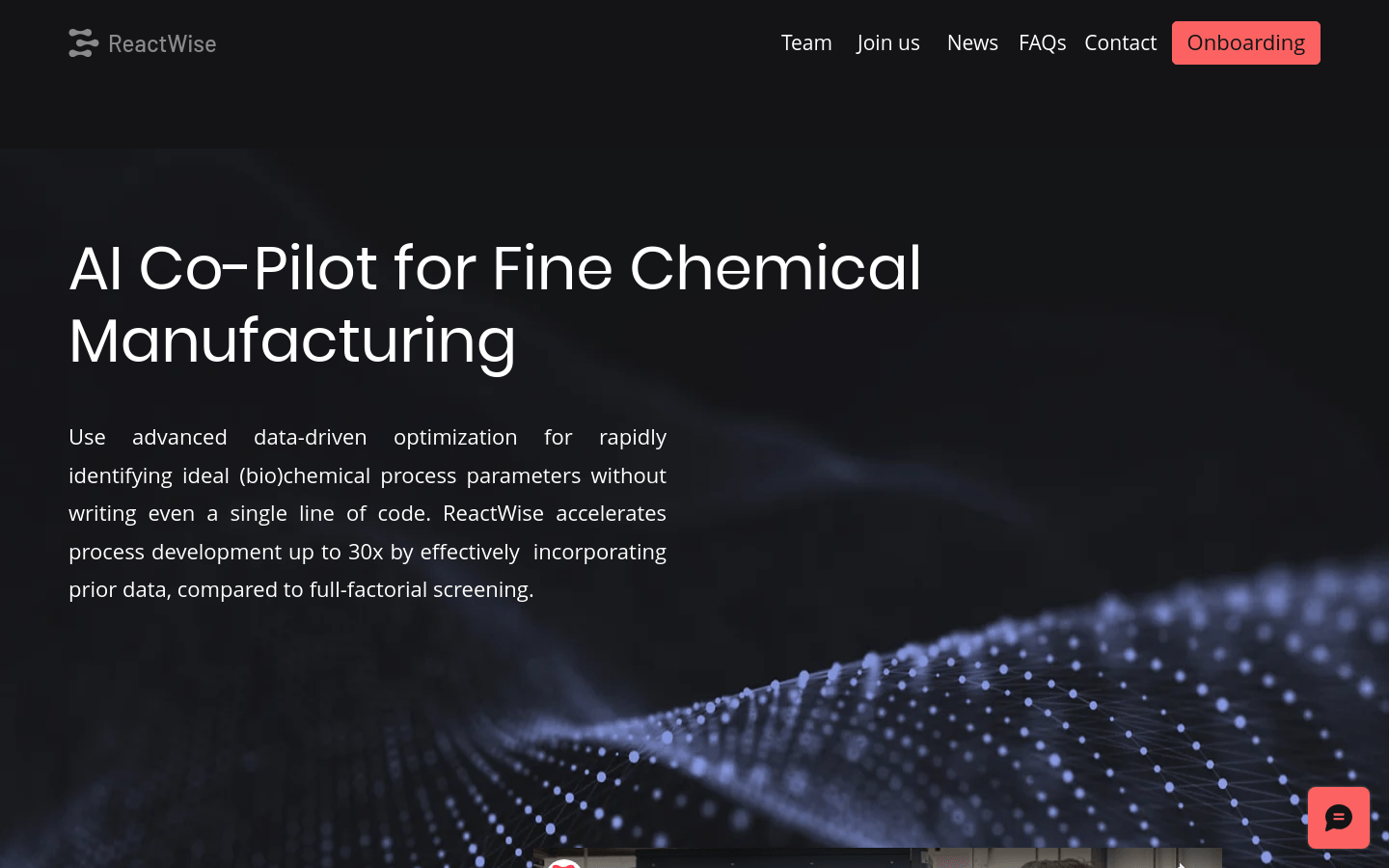
ReactWise is an AI-assisted chemical process parameter optimization platform that utilizes advanced data-driven optimization technology for the field of fine chemical manufacturing. It accelerates process development by up to 30x by efficiently integrating previous data to quickly identify ideal (bio)chemical process parameters without writing any code. Built by researchers for researchers, the platform supports advanced technologies such as multi-task learning and machine learning closed-loop optimization, aiming to advance research and applications in the field of chemistry.
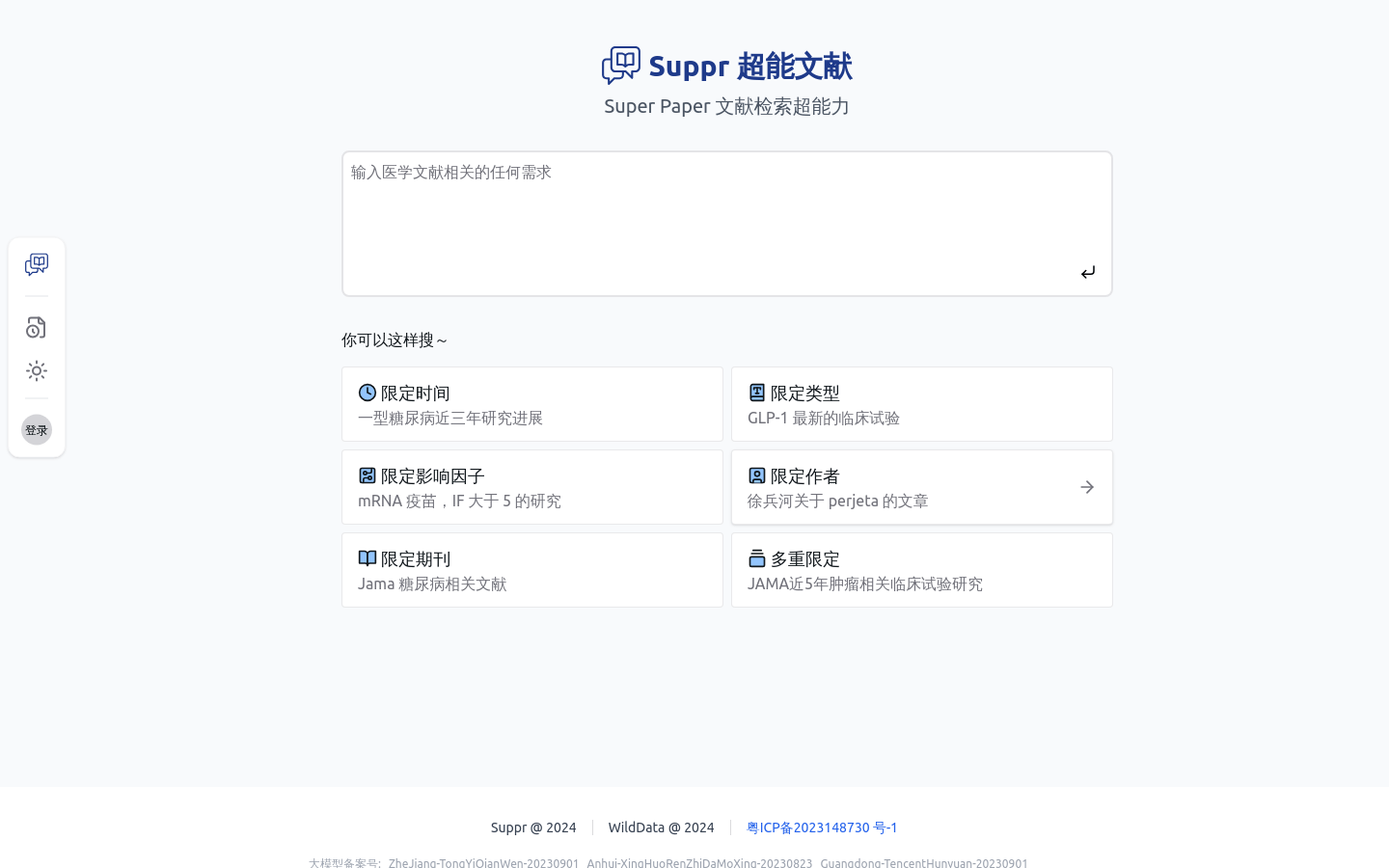
Suppr is a medical literature search engine driven by artificial intelligence technology, designed to help medical researchers quickly retrieve and obtain the latest research progress and clinical trial information in related medical fields. It provides accurate literature retrieval services by limiting multiple conditions such as time, type, impact factor, author, journal, etc., which greatly improves the efficiency and quality of medical research.
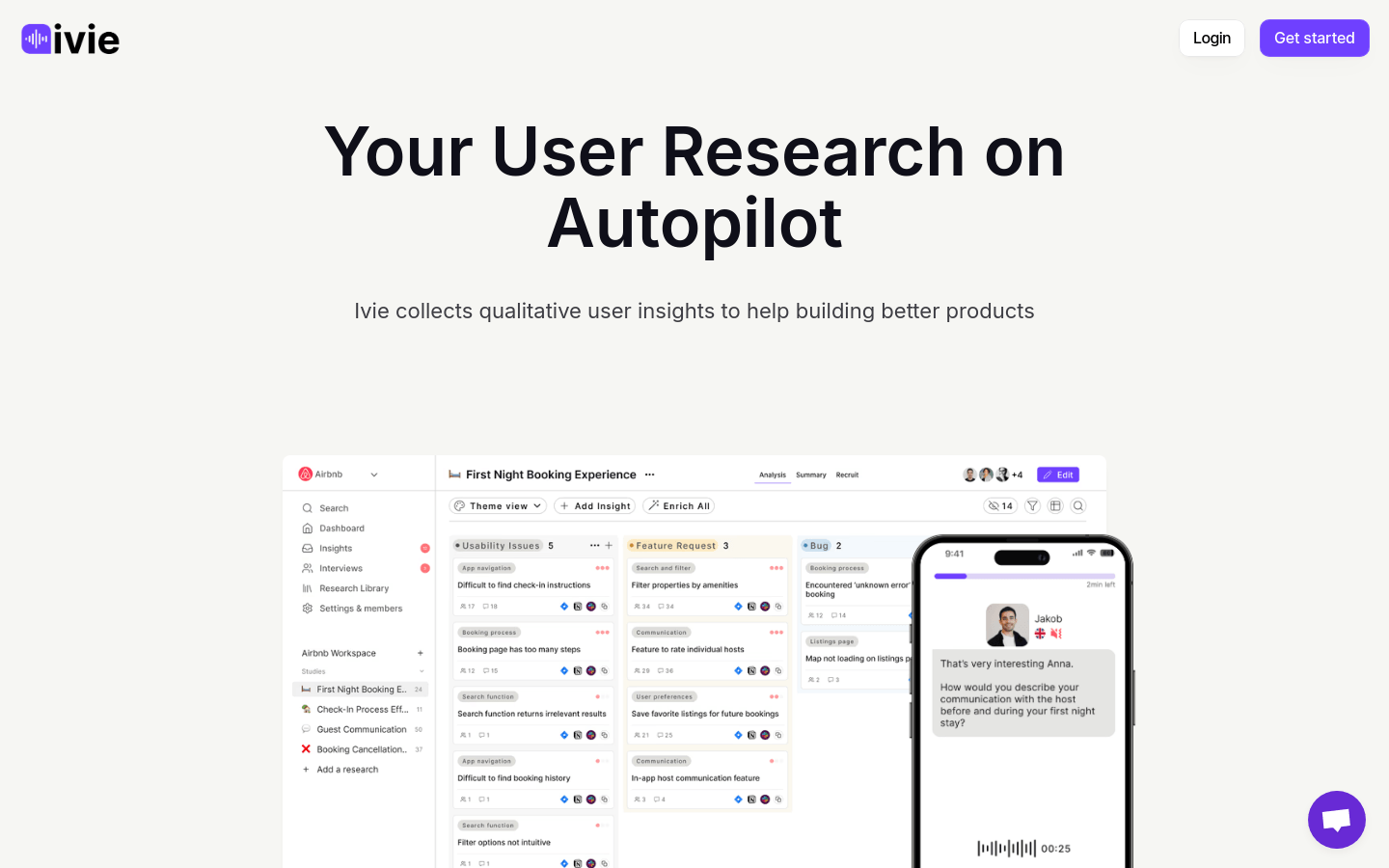
Ivie is a user research platform based on AI technology, designed to help product teams collect and analyze user feedback in an automated way to gain valuable insights to support decision-making. It provides product teams with an efficient and scalable research tool through features such as automated transcription, intelligent topic aggregation, in-depth analysis, and AI-written interview summaries. Ivie supports multiple languages and can conduct customized training according to the company background to ensure the accuracy and relevance of research results.
MAIA (Multimodal Automated Interpretability Agent) is an automated system developed by MIT Computer Science and Artificial Intelligence Laboratory (CSAIL) to improve the interpretability of artificial intelligence models. It automatically performs a variety of neural network interpretive tasks through the support of visual-language models and a series of experimental tools. MAIA provides deeper insights into the inner workings of AI models by generating hypotheses, designing experiments to test them, and refining their understanding through iterative analysis.
SuperCFD is a high-performance fluid dynamics simulation tool that uses cloud computing technology to provide users with fast and comprehensive simulation services. The product is mainly aimed at engineers and scientific researchers who need to perform complex fluid and thermodynamic analysis. It has the characteristics of fast speed, easy operation and high cost-effectiveness.
Afforai is an AI-driven reference management assistant designed to help researchers manage, annotate, cite papers, and conduct literature reviews with the reliability of AI. It provides a completely new way to store research materials, allowing users to focus on what really matters. Afforai supports multiple document formats, including DOI, URL, PDF, etc., and has multiple search modes that can connect hundreds of papers for summary, comparison and translation. In addition, Afforai also provides data citations, allowing users to easily verify the source of information and ensure the reliability of the research.
Exa is a web information organization tool designed for AI applications. It helps users quickly obtain the information they need through semantic search, content crawling, similarity search and other functions to avoid information overload and wrong information. Exa's semantic search can understand semantic meaning, not just keyword matching, to provide more accurate search results. In addition, Exa supports scraping complete and cleaned content from any web page, as well as finding similar results by URL or long text. Exa also provides powerful filtering capabilities, allowing users to search based on domain name, date range or data category. Exa's API supports programming languages such as Python, Javascript and Curl, making it easy to integrate into existing systems.
KYUTAI is a Paris-based artificial intelligence research laboratory with a mission to build and democratize artificial intelligence through open science. This represents an open, collaborative research environment designed to advance the development and application of artificial intelligence technology. KYUTAI Laboratory is committed to education and popularization, allowing more people to understand and get in touch with artificial intelligence by providing online trials and educational lectures.
Safe Superintelligence Inc., a company focused on building safe superintelligence (SSI), founded by OpenAI co-founder and former chief scientist Ilya Sutskever, puts safety above "commercial pressures." The company believes SSI is the most important technology problem of the current era and is committed to solving it through revolutionary engineering and scientific breakthroughs. The company's goal is to rapidly improve intelligence capabilities while ensuring safety remains at the forefront. Its business model ensures safety, security and progress independent of short-term commercial pressures.
AIModels.fyi is a platform focused on the field of AI, providing daily updated summaries of AI papers, models and tools. It uses algorithms to screen out AI developments with significant impact, and transforms complex models and papers into short, clear guides to help users quickly absorb and apply them. In addition, subscribers get personalized AI content, guides to top models, papers, and tools that don’t require a PhD to understand, and exclusive Discord community access to AI experts and builders.
GPT Researcher is a leading autonomous research agent designed for multi-agent frameworks, delivering real-time, accurate and factual results. It simplifies data collection, delivering trusted, aggregated and curated results with a single function call. It supports over 100 different large language models (LLMs) and works with any search engine, from Google to DuckDuckGo. Users can easily search local documents and files and generate long reports of more than 2,000 words, supporting export in multiple formats such as PDF, Word, Markdown, JSON and CSV.
DenserRetriever is an open source AI retrieval model designed specifically for RAG (Retrieval-Augmented Generation). It leverages the power of community collaboration and uses XGBoost machine learning technology to effectively combine heterogeneous retrievers. It is designed to meet the needs of large enterprises, is easy to deploy, and supports docker quick start. It achieves state-of-the-art accuracy on the MTEB retrieval benchmark and is featured on the Hugging Face leaderboard.
OpenCompass Multimodal Ranking is a real-time updating platform for evaluating and ranking different multimodal models (VLMs). It calculates the average score of the model through 8 multi-modal benchmarks and provides detailed performance data. The platform only contains open source VLMs or publicly available APIs and is designed to help researchers and developers understand the latest progress and performance of current multi-modal models.
Artificial Analysis is an independent analysis platform focused on AI language models and API providers. It provides detailed performance evaluations to help users understand the AI landscape and select the best model and API providers for their specific use cases. The platform compares different AI models through multiple dimensions such as quality index, throughput and price, allowing users to make more informed choices.
ANDRE is an automated data analysis engine that leverages advanced artificial intelligence and the best business analysis and insight management methods to transform complex data into clear insights and stories. It can import raw data from any source and provide comprehensive reports with conclusions.
Cubby is a private workspace that stores links and files from anywhere and uses artificial intelligence to annotate and synthesize them. It automatically transcribes audio and video content and provides annotation and download capabilities. Cubby also has an intelligent assistant that can automatically generate summaries, answer questions and perform content synthesis. Cubby aims to provide a tool to centrally store, annotate and synthesize research data to improve work efficiency.
RAGFlow is an open source RAG (Retrieval-Augmented Generation) engine that provides a streamlined RAG workflow based on in-depth document understanding and is suitable for enterprises of all sizes. It combines large language models (LLMs) to provide realistic question-answering capabilities, supporting corroborated citations from data in a variety of complex formats.
Grok is an AI-driven document search platform that helps users upload and analyze documents in various formats. By deeply dissecting document content, Grok can reveal hidden patterns, trends, and connections within documents, providing users with a comprehensive understanding. Users can ask the AI specific details and watch as the intelligent algorithm extracts relevant insights and gives concise answers. Additionally, Grok supports the use of AI to interpret complex code bases. Grok can help users find important features or technologies in the document and highlight its main advantages and background information, positioning and price, etc.
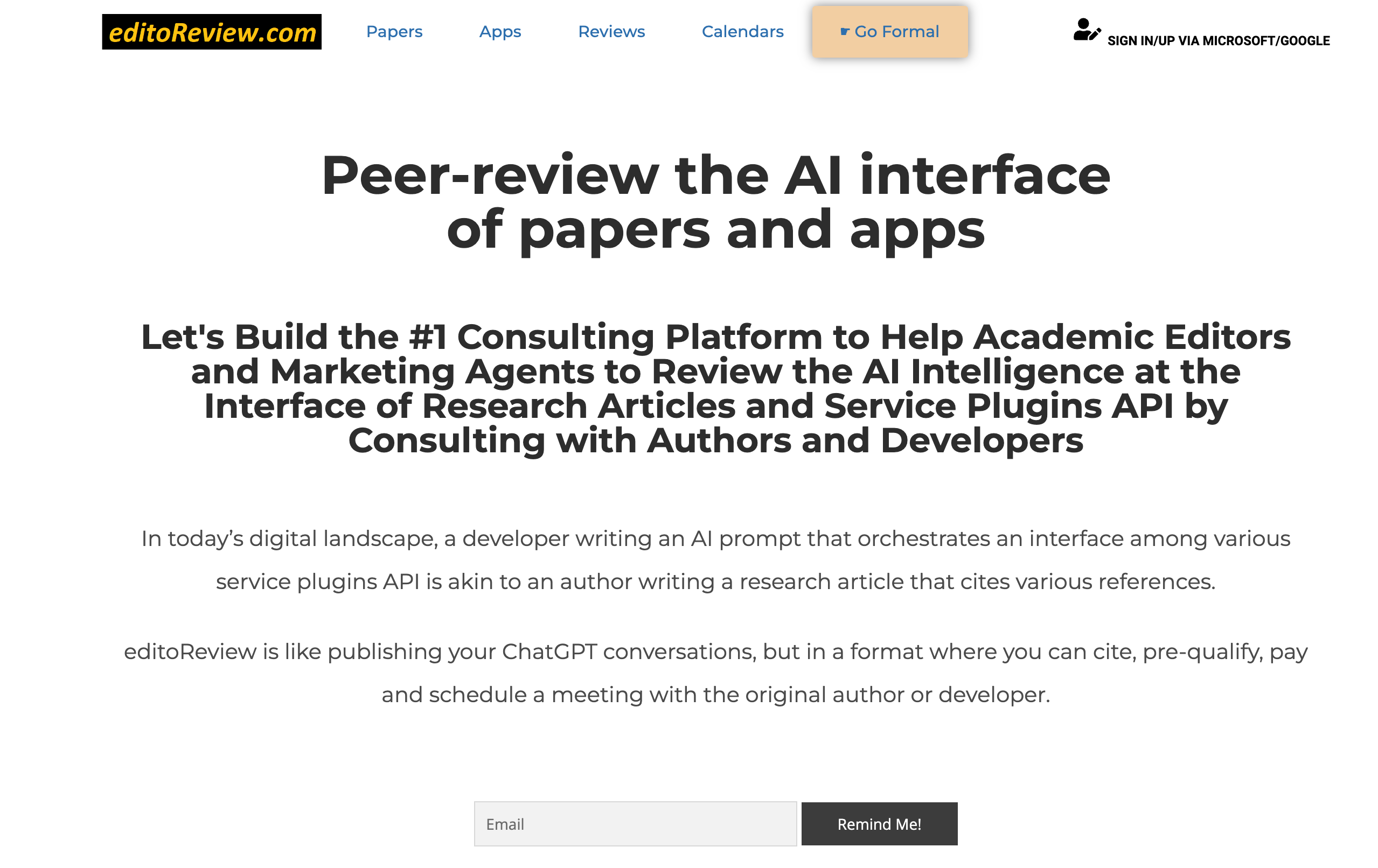
editoReview is a platform that provides consulting services to academic editors and marketing agencies to evaluate the searchability and usability of research articles or service plug-in APIs on AI interfaces. Users can start a new review via an AI chat transcript or template document, cite references or applications to schedule meetings with authors or developers, pay for consultations, and publish shareable review transcripts. editoReview helps editors and marketers clarify the feasibility of papers or service plug-ins in the interface through intelligent search and intelligent usage, and integrates with other papers and applications in arXiv literature and Zapier market.
DOCUBASE.AI can instantly transform your documents into answers, saving valuable time and resources and helping your business grow. It supports document uploading, automatic text extraction, multi-language support, question generation, answer extraction, user-defined questions, document summarization, export options, and feedback mechanisms. You can experience DOCUBASE.AI with a 7-day free trial and cancel the trial at any time.
Graph AI focuses on leveraging graph-structured data and specific algorithms (such as clustering, partitioning, PageRank, and shortest paths) to solve certain problems that involve aspects such as centrality, connectivity, and path analysis in the analysis.
Tavily is your AI research assistant, providing you with fast and accurate insights and comprehensive research. It helps your AI make better decisions and provides an intelligent search API to obtain information in a fast, accurate, and real-time manner. Reduce illusions and bias by connecting LLMs and AI applications to trusted real-time knowledge.
Shilu Huitu is an associative computing platform that extracts associative relationships from multi-source heterogeneous data and uses technologies such as information transmission, relationship fitting and knowledge reasoning to improve data utilization and intelligent decision-making capabilities. The platform has been widely used in financial technology, medical and life sciences, military security and other industries to promote the intelligent transformation of the industry.
Tencent ARC official website is an applied research center under Tencent PCG, dedicated to exploring and challenging cutting-edge smart media technologies. The team brings together first-class high-end talents at home and abroad. Its main research areas include vision, audio, natural language processing, etc., and improves algorithm performance through methods such as AutoML, multi-modal and deep learning. Through a mechanism that decouples business needs and scientific research, ARC cooperates with business teams and is guided by business needs and industry trends to continuously explore, innovate and make breakthroughs. The website provides detailed information about ARC's mission, team introduction, mechanisms and areas.
Sima Yue is a document reading and analysis tool based on artificial intelligence technology. It can quickly extract effective information from complex documents and perform intelligent analysis. It supports functions such as analyzing chart data, parsing multiple file formats, cross-language questions, and customizing expert prompts. Through chat interaction, key information and creative inspiration can be obtained accurately and flexibly, greatly saving time in document reading and information retrieval, and can be efficiently used in work, study and other scenarios.
GenAudit is a tool designed to help verify the response of large language models (LLMs) in document support tasks. It can recommend edits to the LLM response by amending or removing claims that are not supported by referenced documents, and provide reference evidence for facts that appear to be supported. GenAudit performs these tasks by training a model and designing an interactive interface to present suggested edits and evidence to the user.
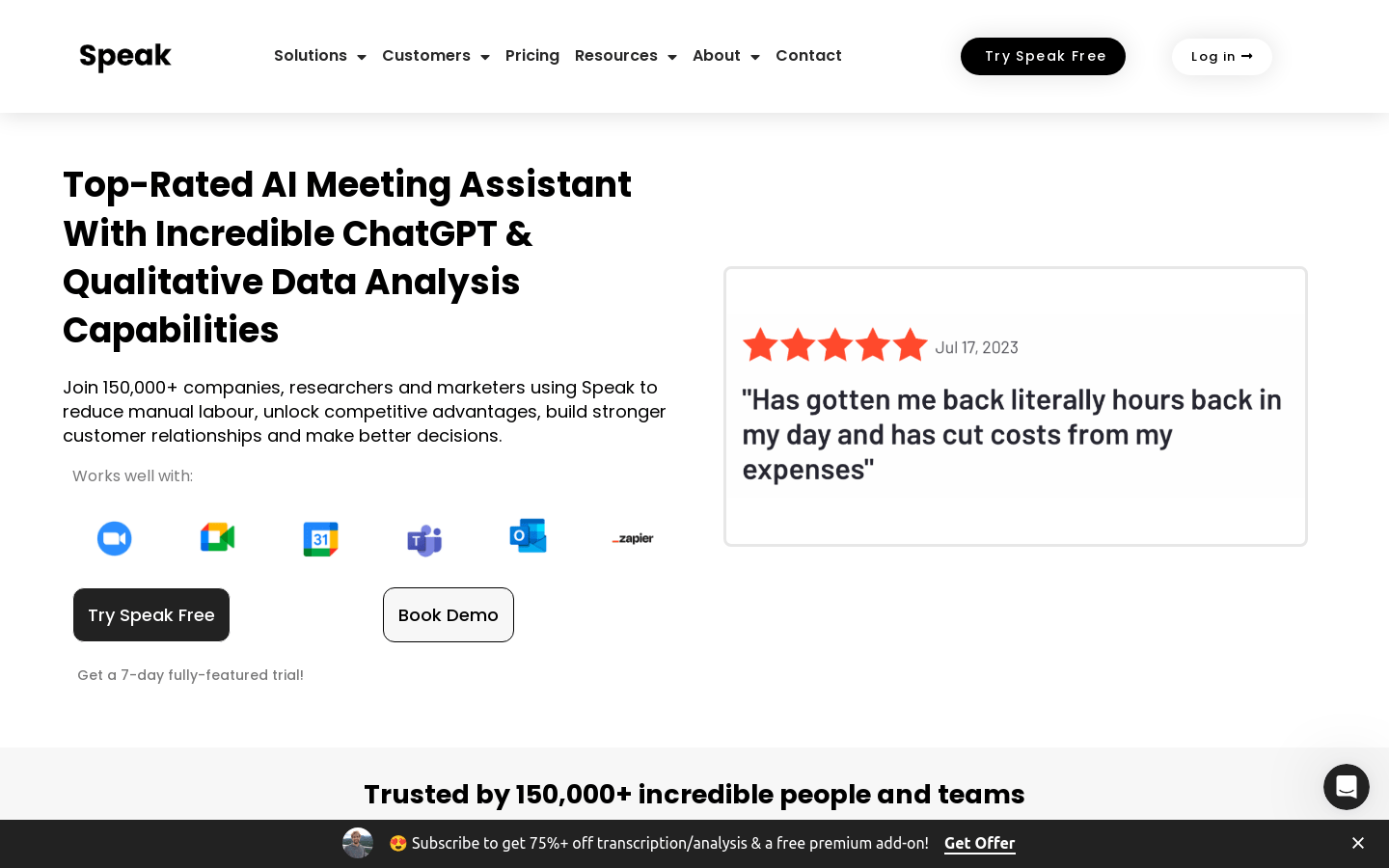
Speak Ai is an AI-powered transcription, research, data analysis and NLP software that helps marketing and research teams turn unstructured audio, video and text into a competitive advantage. It provides automatic transcription, conference assistant, data visualization and other functions to help users save time and improve efficiency.
Explore other subcategories under productive forces Other Categories
1361 tools
904 tools
767 tools
619 tools
607 tools
431 tools
406 tools
398 tools
research tools Hot productive forces is a popular subcategory under 201 quality AI tools